When a tree falls on your house at 2 a.m. during a storm, you don’t have time to research your options. You need someone who picks up the phone, shows up fast, and knows exactly what to do. Emergency tree removal in Pensacola is a real and recurring need — not just for major storms, but for any situation where a tree poses an immediate threat to your home, your family, or your property. At Holston Tree Service, we respond to these situations every week across Pensacola, Cantonment, Gulf Breeze, Milton, and Pace. This guide walks you through what counts as an emergency, what to expect from the process, and how to protect yourself and your property when things go sideways.
Not every damaged tree is an emergency — but some absolutely are. Knowing the difference matters because it affects how urgently you need to act and who you need to call. A tree with a small broken limb after a thunderstorm is probably not an emergency. A tree leaning against your roof after a tropical storm absolutely is.
Generally speaking, a tree situation becomes an emergency when there’s an active or imminent threat to people, structures, or utilities. That includes:
If you’re not sure whether your situation qualifies, our article on what qualifies as an emergency tree removal situation breaks it down in plain terms. And if you want to understand the underlying risk factors that put trees in this category in the first place, read about what makes a tree hazardous in the first place — it’s worth understanding before the next storm season hits.
Pensacola isn’t just any coastal city. It sits in one of the most active hurricane corridors in the country, and the surrounding areas — Gulf Breeze, Pace, Milton, Cantonment — each have their own terrain, soil conditions, and tree canopy characteristics that affect how trees behave under stress.
Much of the Pensacola area sits on sandy, well-drained soil that doesn’t anchor roots the way heavier soils do. After heavy rain, that already-loose soil becomes even less supportive. Trees that look completely healthy can uproot suddenly when the ground becomes saturated — which is exactly what happens during and after tropical weather events. This is one reason why a tree that seemed fine before a storm can be a serious structural hazard within hours of it ending.
Large live oaks, longleaf pines, slash pines, and water oaks are all common throughout Escambia and Santa Rosa counties. These species behave very differently in storms. Pine trees tend to snap under wind load. Oaks often uproot rather than snap. Water oaks, which are common in older neighborhoods around Pensacola, are particularly prone to internal decay that isn’t visible from the outside — making them a hidden hazard. Understanding local species is part of why tree work in Santa Rosa County is genuinely different from other places.
Your first priority is always safety — not documentation, not calling your insurance company, not assessing damage. Here’s the order of operations that makes sense in most emergency situations:
On the insurance side, contact your homeowner’s insurance provider as soon as possible. Coverage for storm-related tree damage varies by policy, and there are time-sensitive steps involved in the claims process. Check your specific policy details and, if needed, consult a licensed insurance professional for guidance on deadlines and documentation requirements.
People sometimes assume emergency tree removal is just a faster version of standard tree removal. In practice, it’s quite different — and understanding the process helps set realistic expectations.
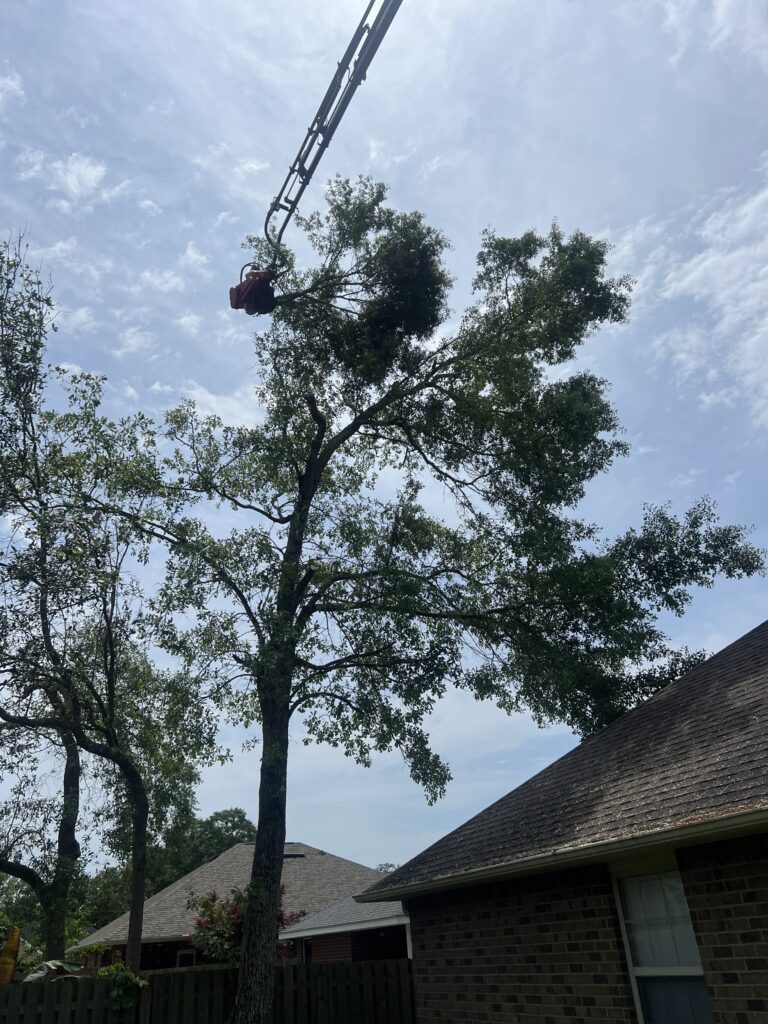
When Holston Tree Service responds to an emergency call in the Pensacola area, the first step is always a quick but thorough assessment of the situation. Is the tree actively moving? Are there additional hazards nearby — other weakened trees, power lines, unstable soil? What’s the safest access point for equipment?
From there, the process typically involves:
Emergency situations often require working in tight spaces, on wet ground, or near structures that have already been compromised. This is not DIY territory, and it’s not a job for a general handyman. It requires trained climbers, proper rigging equipment, and crew members who have done this work under pressure before.
For a broader look at the full range of work a professional tree company handles, our article on what a residential tree service company actually does gives useful context.
No one wants to be calling for emergency tree removal in the middle of a storm. The homeowners who tend to fare best are the ones who had their trees assessed before hurricane season started. A pre-storm inspection identifies trees that are already weakened, leaning, or showing signs of disease — before a 70 mph wind gust makes the decision for you.
Learn more about what a pre-storm tree inspection actually covers and consider scheduling one for your property in Pensacola, Gulf Breeze, Cantonment, Milton, or Pace before the next storm season gets underway. It’s a straightforward service that can genuinely prevent an emergency.
Response times vary depending on the scale of the event and how many calls we’re managing, but emergency calls always go to the front of the line. During widespread storm events — when most of Northwest Florida is calling at once — we triage based on active safety threats. A tree on a roof or blocking a road gets prioritized over one that’s down in a yard. Call us directly and we’ll give you an honest estimate of when we can be there.
It depends on your policy. Many homeowner’s policies cover removal when a tree has caused damage to a covered structure, but coverage for trees that fall in the yard without hitting anything is often more limited. Document everything before any work begins, notify your insurer as soon as possible, and review your policy carefully. For specific questions about your coverage, contact your insurance provider directly.
That depends entirely on where the tree hit and how much structural damage occurred. A small limb through a window is very different from a large trunk on your roof. If there’s any question about structural integrity, err on the side of caution and don’t occupy the affected area until a professional has assessed the situation. When in doubt, move out of that section of the home until it’s been evaluated.
Yes. Holston Tree Service operates throughout the Pensacola metro area, including Gulf Breeze, Milton, Cantonment, and Pace. We’re a local company that works across Escambia and Santa Rosa counties, so wherever you are in this region, we can help.
When you need emergency tree removal in Pensacola or anywhere in Northwest Florida, call Holston Tree Service. We’re a local crew that knows this area, responds fast, and handles the job the right way — whether it’s a single fallen limb or a full storm cleanup across your entire property. Don’t wait until the situation gets worse. Contact Holston Tree Service today and let’s get your property safe.
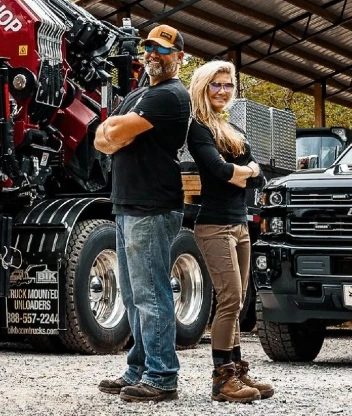
Mike Holston & Amanda Holston are the husband-and-wife team behind Holston Tree Service, serving Pensacola and Northwest Florida with expert tree removal, trimming, and storm cleanup.
Mike oversees operations and customer care, while Amanda is ISA TRAQ-Certified and an ISA Certified Arborist, bringing specialized training in Tree Risk Assessment and advanced pruning prescription plans to every project.
Proudly serving Pensacola, Cantonment, Gulf Breeze, Milton, Molino, Jay, and Pace with certified tree care and 24/7 emergency service.