When a tree on your property starts leaning toward your house, splitting at the trunk, or dropping large limbs without warning, you don’t have time to guess at solutions. You need hazardous tree removal experts who can assess the situation honestly, work safely, and get the job done without making a bad situation worse. At Holston Tree Service, we work with homeowners and property managers across Pensacola, Cantonment, Gulf Breeze, Milton, and Pace to identify and remove dangerous trees before they cause serious damage — or after a storm already has.
Not every tree that looks rough is dangerous, and not every tree that looks fine is safe. Understanding what actually makes a tree hazardous helps you make smarter decisions about what needs immediate attention and what can wait.
Here are the most common signs that a tree has crossed from “unhealthy” into genuinely dangerous territory:
In the Gulf Coast region, trees face a unique combination of stressors — high humidity, sandy soil, hurricane-force winds, and frequent storm activity. A tree that might survive in drier climates can deteriorate quickly here. If you’re curious about how local conditions affect tree health and maintenance, this article on why tree trimming in Santa Rosa County is different from other places explains some of those regional factors in detail.
Some homeowners attempt to remove smaller problem trees themselves, and occasionally that works out fine. But hazardous tree removal is a different category entirely. When a tree is already compromised — structurally unstable, storm-damaged, or in a tight space near structures — the risks multiply quickly.
A healthy tree in an open yard has some margin for error during removal. A hazardous tree has almost none. If the trunk is rotted, it won’t behave predictably when cut. If the root system is compromised, the tree can shift or fall in an unexpected direction. If large limbs are already hanging or partially split, the vibration from a chainsaw can send them down before you’re ready.
Trained hazardous tree removal experts know how to read a damaged tree, plan the fall or sectional removal, use rigging to control where pieces land, and work around power lines, structures, and vehicles. That experience and equipment isn’t something you improvise on a Saturday morning.
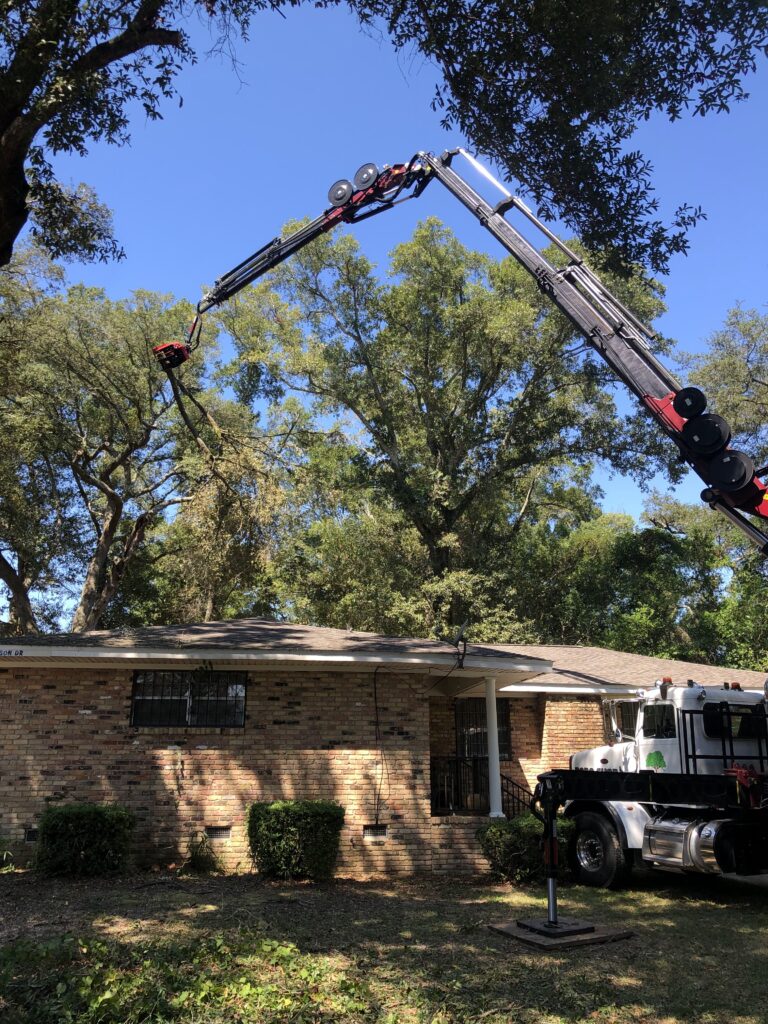
Professional tree removal crews use rigging systems, cranes for particularly difficult situations, aerial lifts, and specialized cutting techniques that aren’t available to most homeowners. For trees close to homes in Pace or Cantonment, or trees overhanging pools and structures in Gulf Breeze, that level of control is the difference between a clean removal and a disaster.
Understanding what professional tree services actually involve — beyond just showing up with a chainsaw — is worth knowing before you hire anyone. This breakdown of what tree trimming services actually include gives a clearer picture of what real professional work looks like.
A legitimate hazardous tree removal expert doesn’t just look at the tree — they look at everything around it. The assessment process typically includes:
A Pensacola arborist can also evaluate whether a tree that looks dangerous might actually be saved with proper pruning or treatment — or whether removal is the only responsible option. Not every compromised tree needs to come down, but some absolutely do, and getting that assessment from a qualified professional matters.
The Pensacola area sees its share of severe weather — tropical storms, hurricanes, and fast-moving squalls that can damage trees in minutes. After a major storm, the landscape changes fast, and some of the most dangerous situations involve trees that are partially uprooted, hung up in other trees, or pressing against structures.
Emergency hazardous tree removal is specialized work. The tree is often under tension in unpredictable ways. Root plates may be partially lifted. Limbs may be suspended above people or vehicles. This is exactly the situation where calling hazardous tree removal experts instead of attempting anything yourself is the right call.
If you want to understand how storm-safe tree care actually works — and what separates genuinely storm-prepared trees from ones that just look fine — this article on what storm safe tree services actually mean is worth reading before hurricane season.
After the tree is removed, don’t overlook the stump. Leaving a stump behind creates its own set of problems — pest attraction, regrowth, and tripping hazards. Here’s why stumps are more than just an eyesore and why stump grinding is often the right follow-up step.
Holston Tree Service works throughout the greater Pensacola area, including Gulf Breeze, Milton, Pace, and Cantonment. We understand how local soil conditions, coastal weather patterns, and the specific tree species common to Northwest Florida affect the risks involved in tree removal. That local knowledge makes a real difference when we’re assessing a compromised live oak in a Gulf Breeze backyard or responding to storm damage in a Cantonment neighborhood after a fast-moving storm.
Whether you have a tree that’s been worrying you for months or you’re dealing with something that came down last night, our team is equipped to handle it safely and efficiently.
Common warning signs include a sudden or significant lean, cracks or splits in the trunk, large dead limbs, fungal growth at the base, and visible root damage. After a storm, any tree that’s partially uprooted or has large limbs hanging in the canopy should be assessed immediately. When in doubt, have a professional look at it — an honest assessment costs far less than a tree through your roof.
It depends on your specific policy and the circumstances of the damage. Many policies cover tree removal when a tree falls and damages a covered structure, but coverage for hazardous trees that haven’t fallen yet varies considerably. Check your policy directly and talk to your insurance agent for specifics — coverage terms differ, and we can’t make that determination for you.
We offer emergency tree removal services for situations that can’t wait. Response times vary depending on current workload and the nature of the situation, but we prioritize genuinely dangerous scenarios — trees on homes, blocking access, or creating immediate safety hazards. Call us directly and describe the situation so we can give you an accurate estimate of when we can be there.
Trees near power lines require extra care and specific protocols. We assess these situations carefully and work safely around utility infrastructure. In some cases, coordination with the local utility company is necessary before work begins. We’ll walk you through what’s involved during the assessment so there are no surprises.
Don’t wait on a hazardous tree. If you have a tree that’s showing warning signs — or one that came down in a storm — the team at Holston Tree Service is ready to help. We serve Pensacola, Cantonment, Gulf Breeze, Milton, Pace, and the surrounding area with honest assessments, safe removal, and straightforward pricing. Contact Holston Tree Service today to schedule an evaluation or request emergency service.
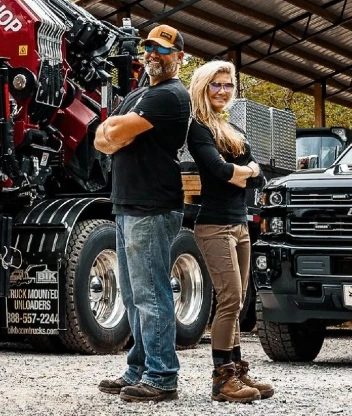
Mike Holston & Amanda Holston are the husband-and-wife team behind Holston Tree Service, serving Pensacola and Northwest Florida with expert tree removal, trimming, and storm cleanup.
Mike oversees operations and customer care, while Amanda is ISA TRAQ-Certified and an ISA Certified Arborist, bringing specialized training in Tree Risk Assessment and advanced pruning prescription plans to every project.
Proudly serving Pensacola, Cantonment, Gulf Breeze, Milton, Molino, Jay, and Pace with certified tree care and 24/7 emergency service.